Karate for girls: confidence, boundaries and strength without aggression
By Sensei Sam Seigers · 4th Dan Seiwakai Goju Ryu · Founder, Yushukan Karate, Tweed Heads South
Girls thrive in a well-structured karate program because it builds real capability, not performance. Here is what to expect at the Tweed Heads South Honbu Dojo.
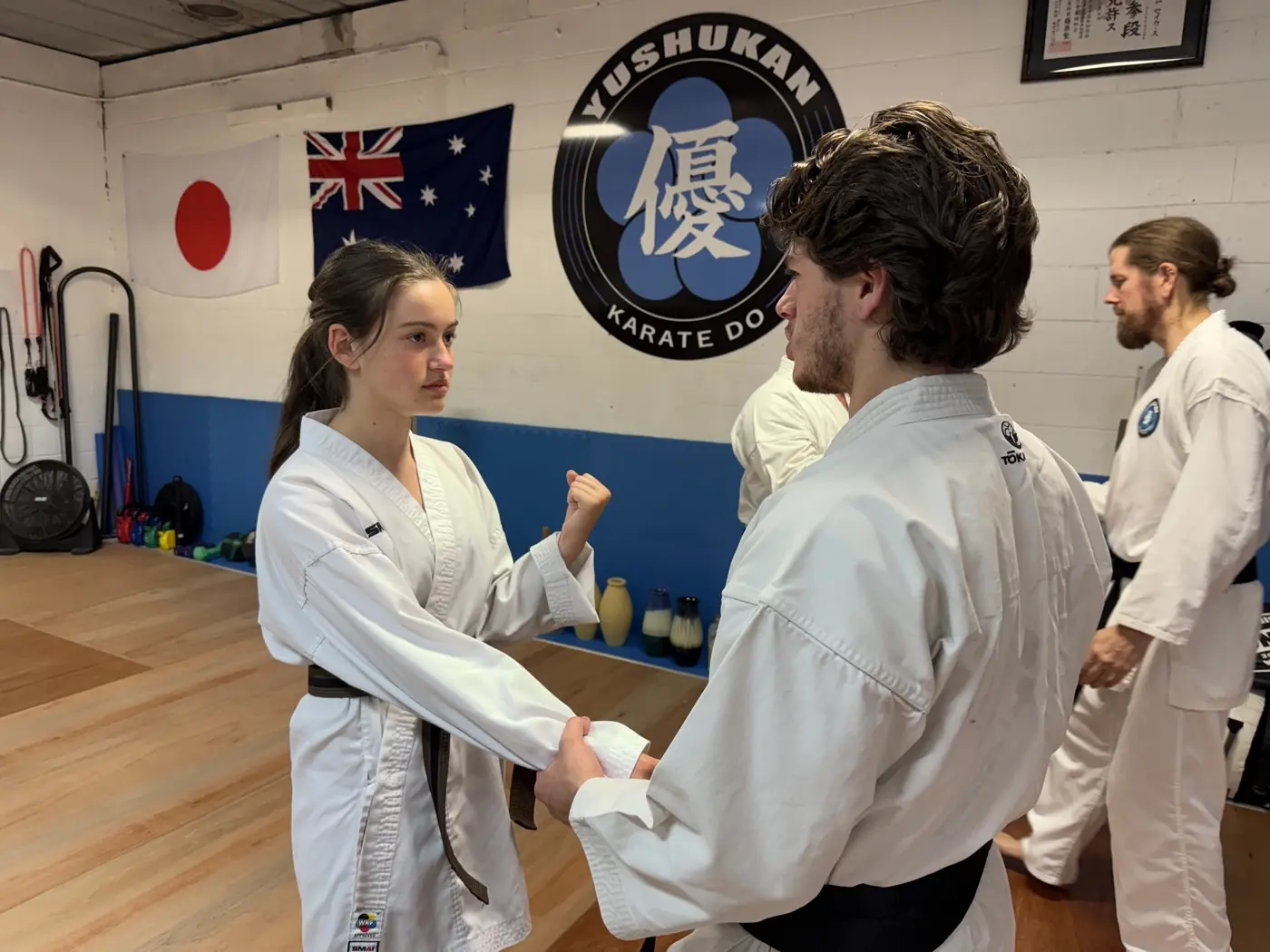
Karate for girls is not about being fearless or unstoppable. It is about being capable, which is a quieter and more useful thing. After more than 25 years teaching girls and women at the Yushukan Karate Honbu in Tweed Heads South, the clearest pattern is a simple one: girls who train with consistent standards carry themselves differently, and that difference shows up everywhere.
Why girls start karate
The reasons vary. Some parents bring their daughters because they are being bullied and need something that builds real confidence, not just reassurance. Some girls ask to start because a sibling trains or because they want something physical that is not team sport. Some are shy and looking for a structured environment where the expectations are clear. Some are already physical and want a challenge.
All of those are good reasons to start, and none of them require a child to already be confident or assertive. The dojo does not ask girls to perform confidence before they have it.
Confidence without aggression
This is probably the most common concern parents have: that teaching a girl to kick and punch will make her harder to manage at home, or more confrontational with siblings or peers. The honest experience at Yushukan is the opposite. Girls who are aggressive because they feel small or uncertain generally become calmer as real capability builds. Girls who are shy and hesitant gradually take up more space, not through aggression, but through ease.
The dojo frames karate as a discipline, not a weapon. Those are not the same thing, and children understand the difference very clearly when it is explained directly.
Voice, posture and boundaries
Three changes parents notice first, usually within the first six weeks. Posture straightens. Eye contact holds longer. And when a girl wants something stopped, she says so with more steadiness and less anxiety. None of those require a physical confrontation. They are the product of training in a space where standards apply equally and where a girl's progress is measured by what she can actually do.
Self-defence as awareness, not fear
Yushukan teaches self-defence within the context of karate training, not as a separate fear-based module. The useful parts of self-defence for a girl's real daily life are almost never about techniques. They are about reading a situation early, asserting clearly, and removing herself from it. Those are trained through the etiquette and discipline of the dojo long before any physical skill is added.
When physical technique is taught, it is taught in the context of the broader system: what karate is for, when it is appropriate, and what the dojo expects of any student who uses it outside the room. Girls receive the same clear framing as boys.
Girls who are sporty, shy, strong or unsure
All four types arrive regularly at Yushukan. Sporty girls usually settle into the structure quickly and enjoy the individual progression. Shy girls often take two or three sessions to relax, then find the predictability of the dojo is exactly what they were looking for. Strong girls who are used to physical activity sometimes find the breath and posture work more challenging than the physical part. Girls who are unsure tend to surprise themselves inside a month.
The common thread is that progress is individual. Girls are not compared to each other or ranked socially. They are assessed against the standard and against where they started.
Questions parents usually ask
- Is karate too rough for girls? No. Partner work is supervised and controlled. Beginners do not free spar. Girls train at the intensity appropriate to their grade.
- My daughter is very shy: will the class be overwhelming? No. We do not call shy students out or put them on the spot early. The dojo structure gives them a clear way to belong without social performance.
- What age can she start? Kids Karate Ready is open from age 7.
- Are there other girls in the class? Yes, girls train through all levels at Yushukan.
Where to start
Karate Ready Kids is the structured three-week starter. Seven in-dojo sessions, online support, and a Week 4 check. $99 for a single enrolment, $90 each for two or more family members. No pressure, no lock-in.
Read is karate good for a shy child if that is the bigger question, or see the full kids karate 7 to 12 page for how the program runs.
Written by Sensei Sam Seigers, 4th Dan Seiwakai Goju Ryu and 3rd Dan All Japan Karate Federation Gojukai. Sam founded Yushukan Karate in 2020 at the Tweed Heads South Honbu Dojo (Unit 3/58 Machinery Drive, Tweed Heads South NSW 2486). He continues to travel to Japan and Okinawa to train under Seiichi Fujiwara Hanshi and other senior teachers.
Yushukan Karate teaches traditional Goju Ryu to kids 7+, teens, and adults. Beginners start with Karate Ready, a structured 3-week pathway.