What is Sanchin?
By Sensei Sam Seigers · 4th Dan Seiwakai Goju Ryu · Founder, Yushukan Karate, Tweed Heads South
Sanchin means three battles: mind, body and spirit. A foundational Goju Ryu kata that builds posture, breathing and focus that transfers off the mat.
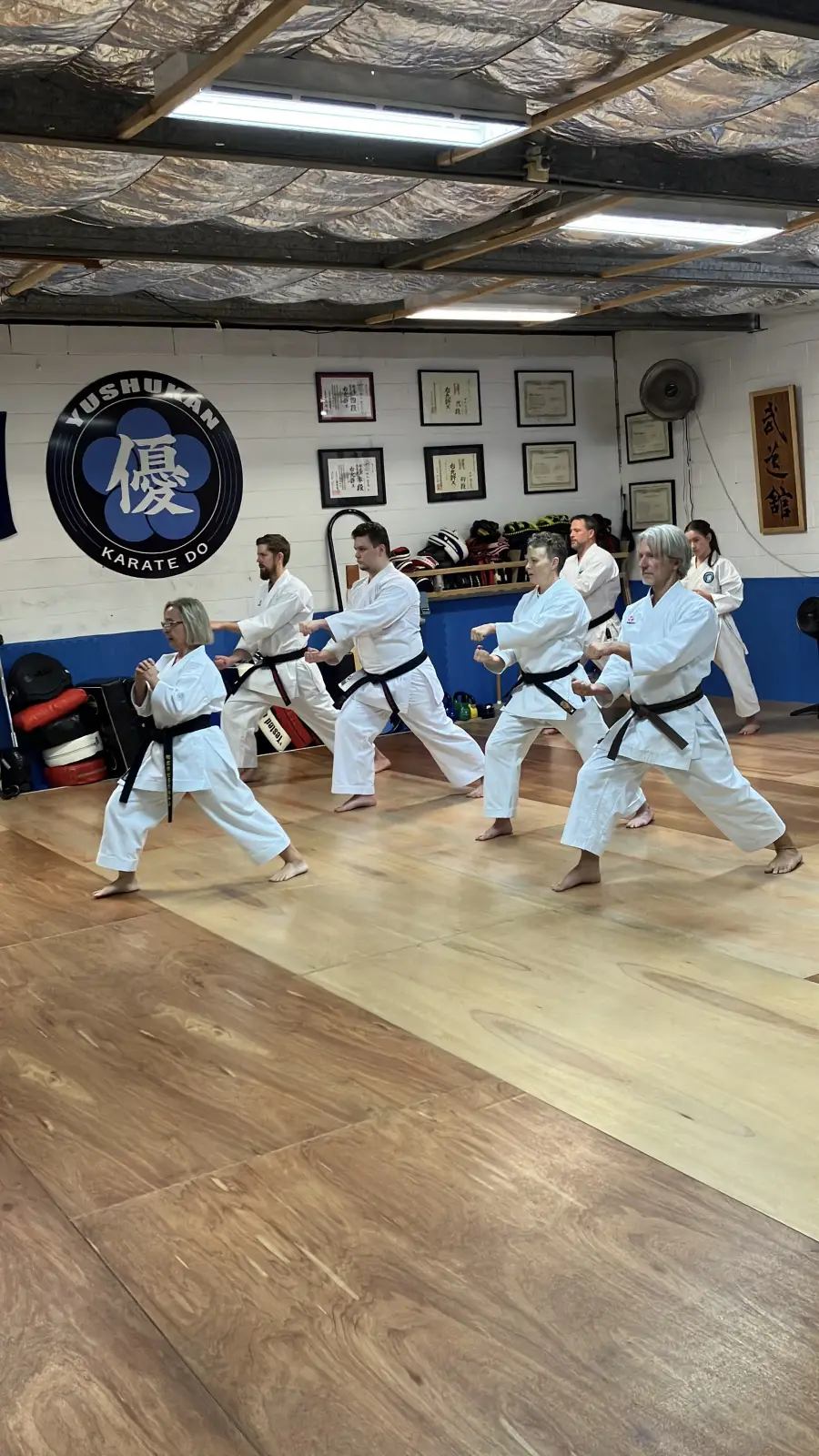
At Yushukan Karate in Tweed Heads South, Sanchin is one of the most important kata in the curriculum. The name translates as three battles, often understood as the unity of mind, body and spirit. Unlike kata that are judged mainly on shape and timing, Sanchin is about posture, breathing, structure, focus and body connection. Most students describe it as the part of training they take home with them.
What Sanchin actually is
Sanchin is a short kata in terms of shape: a small number of stances, a small number of techniques. The technical content is not the point. The point is what you do inside the shape. Tension, relaxation, breath control, posture, and the integration of all of them in a way that holds under pressure.
The kata is performed slowly and deliberately. Every movement is held long enough that any structural weakness becomes visible to the instructor and to the student. There is nowhere to hide in Sanchin, which is why it has been used as both a teaching tool and a test in Goju Ryu since the style was formalised by Chojun Miyagi.
How it is taught
At Yushukan, Sanchin is introduced first as a posture and breathing practice, not a hard-conditioning drill. Students learn to stand, breathe and stay connected through the body. Initially it is taught without shime, the structural check, so the student can find the basics without external pressure.
As rank progresses, the kata is tested through shime: a checking of structure and tension carried out with control by the instructor or a senior grade, matched precisely to the student. Shime is never used to overwhelm or punish. Its purpose is to find the weak link and give the student the feedback they need to fix it. Done correctly, it makes the kata clearer, not harder.
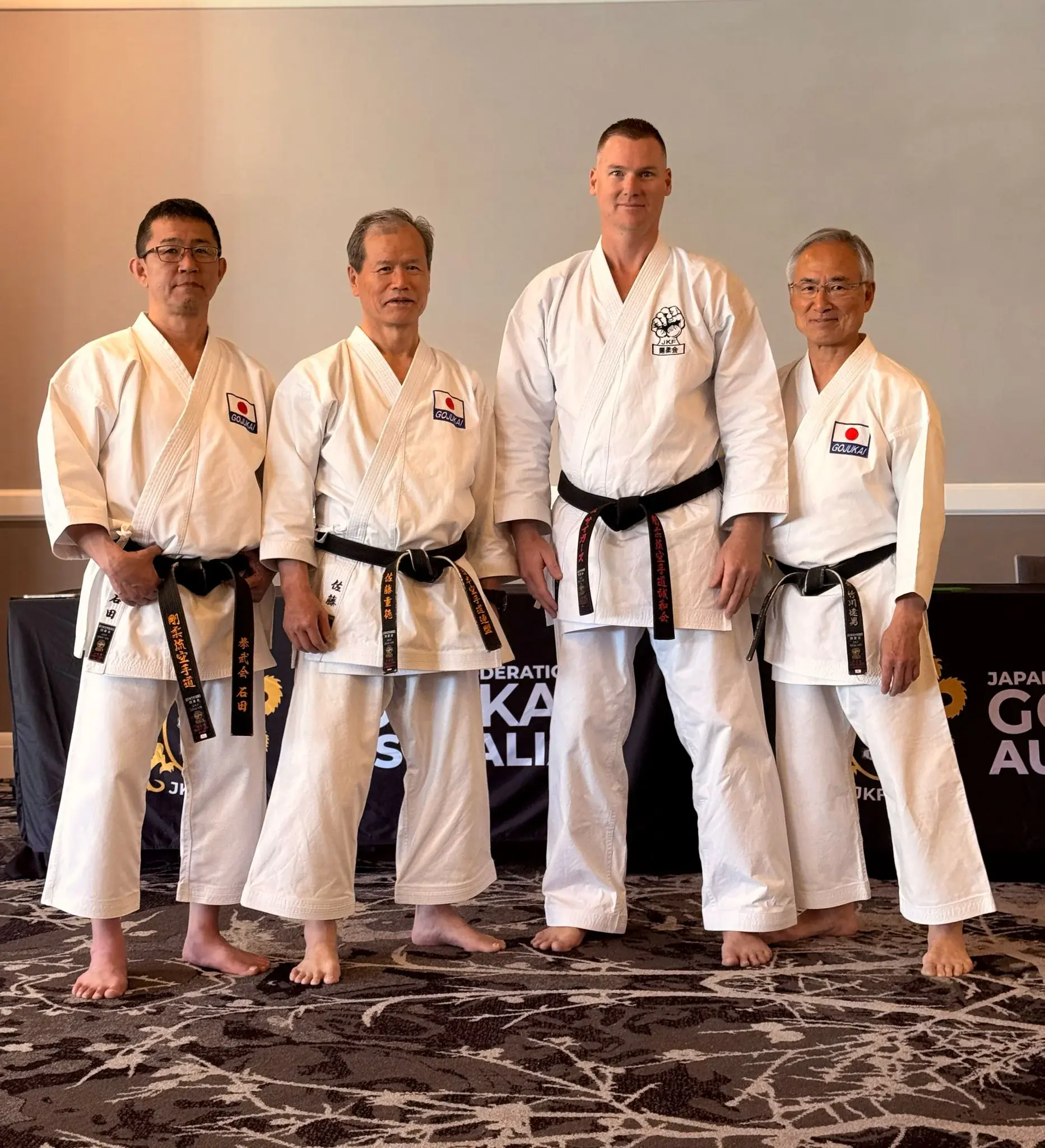
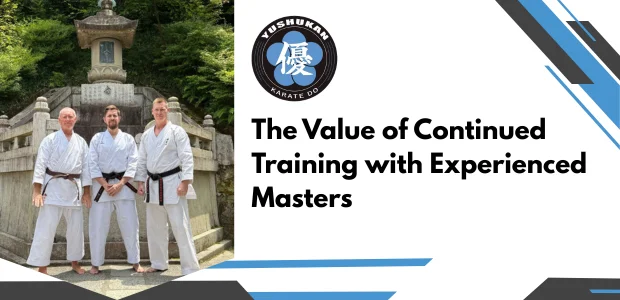
This is one of the places where the lineage matters. Yushukan teaches Sanchin to the Seiwakai and JKF Gojukai standard, which is the version Sensei Sam continues to refine through ongoing training with Seiichi Fujiwara Hanshi and other senior teachers.
Why adults love it
The breathing pattern in Sanchin transfers off the mat. Adults regularly describe using it at the desk, in traffic or before sleep. Many students find the steady breathing helps them feel calmer and more centred, and the posture demands carry into how they sit and stand through the day. For many it becomes one of the most valuable parts of training.
It also works for the body. The posture demands of Sanchin reveal where the structure is weak: in the lower back, the hips, the shoulders. Practising the kata over months tightens the structure quietly. People walk differently because of it.
Sanchin is not breath holding or hyperventilation
Some martial arts content online confuses Sanchin with breath-holding or with the kind of breathing techniques used in pranayama or in some hard styles of karate. At Yushukan, that is not how it is taught. Breath in Sanchin is steady, controlled and integrated with movement. It is not a performance and it is not a competition with the body.
Common questions
How long does it take to learn? The shape of Sanchin is usually clear within a few months. The depth of it takes a lifetime. That is the point of the kata, and it is one of the things students like most about it.
Do beginners learn it? Yes, in stages. White belts learn the stance and the breathing first. The full kata comes through coloured belt grades.
Is it dangerous? Done well, no. Done badly, like anything in karate, it can cause problems. That is one of the reasons it is taught carefully and tested by senior instructors only.
How to experience it
Sanchin is taught in every term at Yushukan. To experience it, the place to start is Karate Ready, our three-week beginner pathway. Read what is junbi undo for the warm-up that prepares the body for Sanchin, and what is goju ryu karate for the broader picture of where it sits in the system.
Written by Sensei Sam Seigers, 4th Dan Seiwakai Goju Ryu and 3rd Dan All Japan Karate Federation Gojukai. Sam founded Yushukan Karate in 2020 at the Tweed Heads South Honbu Dojo (Unit 3/58 Machinery Drive, Tweed Heads South NSW 2486). He continues to travel to Japan and Okinawa to train under Seiichi Fujiwara Hanshi and other senior teachers.
Yushukan Karate teaches traditional Goju Ryu to kids 7+, teens, and adults. Beginners start with Karate Ready, a structured 3-week pathway.