Will karate make my child more aggressive at school?
By Sensei Sam Seigers · 4th Dan Seiwakai Goju Ryu · Founder, Yushukan Karate, Tweed Heads South
The most common question parents ask before enrolling a child. The honest answer is the opposite. A well-run dojo builds control, not aggression. Here is how Yushukan handles it.
It is the most common question parents ask before they enrol a child at Yushukan Karate in Tweed Heads South, and the honest answer is the opposite of what most people fear. A well-run dojo does not make children more aggressive. It teaches control, and the calmer kind of confidence that follows from real capability rather than show.
The short answer
Karate taught well should reduce aggression, not increase it. The principle Yushukan works from is the same one most Australian parents already teach at home: never start a fight, but always know how to walk away from one without becoming a target. That is the goal. Every element of the training is pointed at it.
Why the fear is understandable
The concern is a fair one. You are signing your child up to learn strikes and kicks. Of course you wonder whether those skills will come home in the wrong way. Parents of younger kids especially worry about the sibling situation, or about what happens when another child at school says the wrong thing.
The answer depends almost entirely on how the dojo frames it. A dojo that teaches technique without framing is a dojo that has skipped the most important part.
How Yushukan teaches control
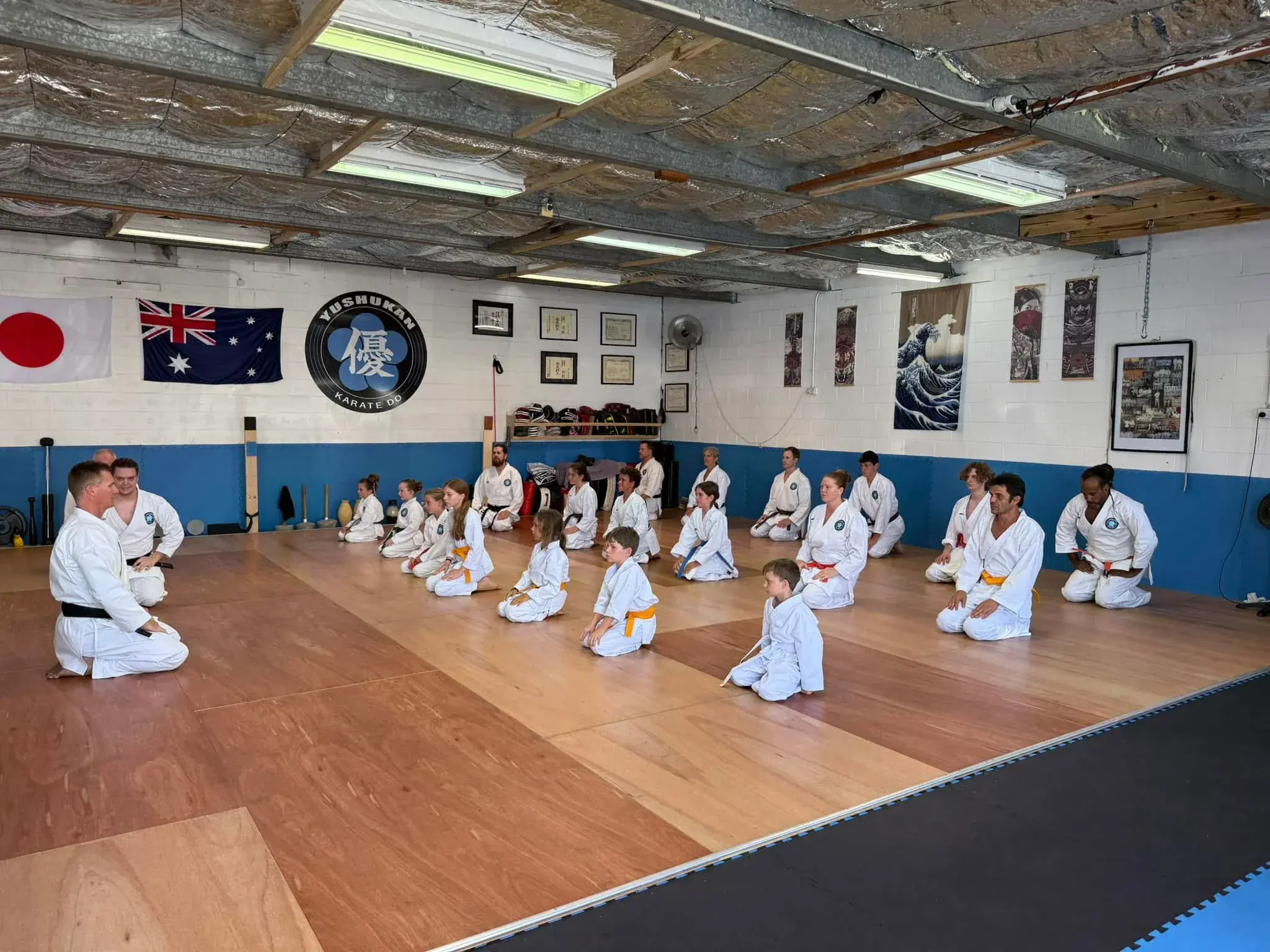
When children first start, they are naturally keen to try their new skills. That is normal and expected, and we plan for it. In the first few classes we have a direct conversation: where these skills can be used, where they absolutely cannot be used, and the consequences of using them outside the dojo. Children understand this very clearly. They are told they would be asked to leave, and why.
The class structure then becomes the outlet. The dojo is the place where you practise. The discipline of bowing in, training hard, and bowing out gives that energy somewhere to go. Children who previously acted out often settle because they now have a sanctioned space to be physical in a structured way.
Confidence and aggression are not the same thing
The change parents notice most is not more aggression. It is less of the anxiety that drives it. Children who were aggressive because they felt small or uncertain become calmer once real competence starts to build. A child who knows they can defend themselves rarely needs to prove anything at school.
Posture changes first: upright, easy, unhurried. Eye contact follows. Then the quality of conversations at home shifts. These are the signs that confidence is landing in the right way.
What happens if a child misuses it
If a child uses karate outside the dojo against another child, we have a direct conversation with them and with you. Aggression at school is treated as a serious breach of dojo values, not as a side effect we absorb. If the situation is serious, the child may be asked to step away from training until the trust is re-established. The dojo is not a place where that behaviour is condoned, and the child knows it from the start.
Questions parents often ask
- My child is already aggressive: will karate make it worse? Tell us before the first class. If a child arrives with significant behavioural challenges, we can plan for it and check in with you after each session. If karate is clearly not helping, we will tell you that too.
- What about sparring? Beginners do not free spar. Partner work in the early months is cooperative, not competitive. See what sparring actually looks like at Yushukan for how that progression works.
- How long before I see a change? Most parents notice something within six weeks. The posture changes first, usually within two or three sessions.
- What if the dojo environment itself is too intense? The class is structured but it is not harsh or loud. Discipline at Yushukan is calm and consistent. It rarely feels intense to a child who has been told what to expect.
What to do next
Read karate, confidence and bullying for the posture, voice and exit sequence we teach children dealing with bullying. Or read is karate good for a shy child if that is the other half of the question.
When you are ready, Kids Karate Ready 7 to 12 is the structured three-week start. $99 for a single enrolment, $90 each for two or more family members, no lock-in.
Written by Sensei Sam Seigers, 4th Dan Seiwakai Goju Ryu and 3rd Dan All Japan Karate Federation Gojukai. Sam founded Yushukan Karate in 2020 at the Tweed Heads South Honbu Dojo (Unit 3/58 Machinery Drive, Tweed Heads South NSW 2486). He continues to travel to Japan and Okinawa to train under Seiichi Fujiwara Hanshi and other senior teachers.
Yushukan Karate teaches traditional Goju Ryu to kids 7+, teens, and adults. Beginners start with Karate Ready, a structured 3-week pathway.